A non-resident founder will be able to register an EU Inc fully online, with no local director, no residency requirement, and no notary or physical attendance once registrations open in Q1 2027. The framework is built around a 48-hour target window and a statutory fee under EUR 100, so the question is no longer whether you can do it from abroad. It is how clean your setup is before launch.
If you have ever tried to open a company from outside the EU, you know where the pain actually sits. The filing is rarely the hard part. The hard part is the country-specific friction around identity checks, bank onboarding, tax setup, and local substance rules.
The short version for non-resident founders.
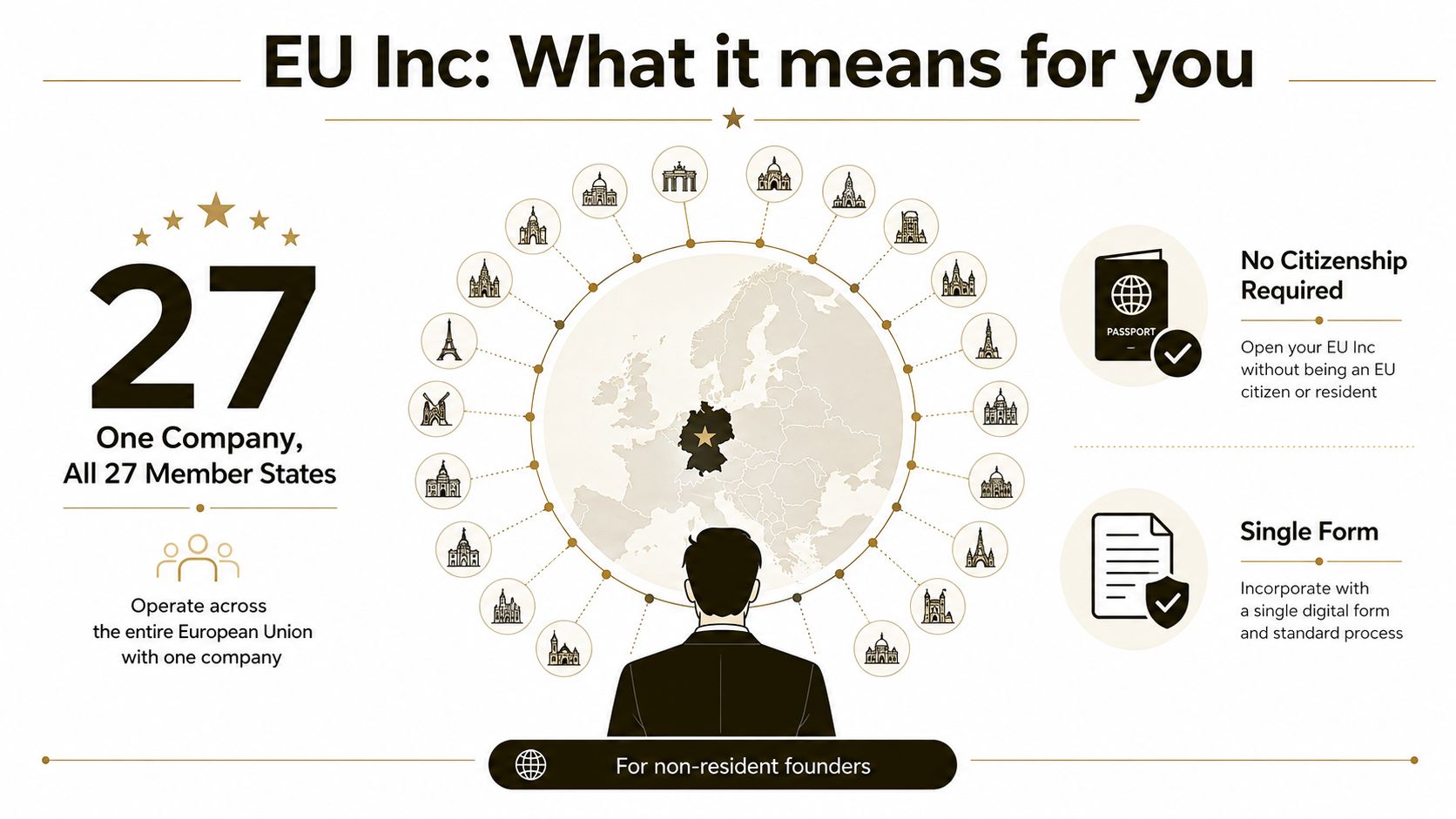
An EU Inc changes the starting point for cross-border incorporation. Instead of forcing you to build around one national filing culture, it gives you a single EU company form designed for cross-border use, supported by the existing register network that already lets authorities search company records across the bloc through BRIS and the Commission's business-register portal (EU business-register portal).
For a founder outside the EU, that is the part that matters. You are not stitching together separate companies just to sell, hire, or invoice across multiple markets. You are getting one entity accepted across the region. The legal architecture behind it is the 28th regime, an optional EU-level rulebook that runs alongside the 27 national ones.
The proposal says founders should be able to form a company within 48 hours, through an EU-level interface, for less than EUR 100, with no minimum share capital requirement and a single submission of company information (European Commission). The draft framework sets a EUR 1 capital benchmark and imposes no citizenship or residency condition on founders.
That is the headline. The more useful reading is simpler.
Practical rule: an EU Inc removes the old barriers first. It does not remove the need for a sensible operating base.
The structure still has a legal home. That is why the non-resident angle matters. You are not deciding whether to incorporate at all. You are choosing the least painful way to anchor a company that can work across the EU from day one.
Treat the timing with realism. The legislation is still moving, and the launch target is Q1 2027. The right move now is preparation, not assuming the regime is already live. We track where the file actually stands in is EU Inc real.
A good waitlist entry does more than reserve a spot. It forces the decisions that make or break a non-resident filing to happen early, before the launch window turns into a paperwork scramble. If you leave the home member state, the business description, or the share setup until the last minute, you lose the main advantage of the waitlist.
Start with the home member state. That choice fixes the company's register, shapes how tax handling gets organised, and sets the practical substance expectations that follow. Choose it on purpose, not by habit.
Then settle three more things.
The waitlist intake matters because it captures those choices before launch. Submission can then move the moment national systems open, instead of forcing you to assemble the file under pressure. The full field-by-field list is in our guide to EU Inc registration requirements.
The strongest pre-launch files are boring. They show one founder profile, one ownership picture, and one target state. They keep names and addresses written the same way everywhere. That sounds minor. It is not.
If your name appears three different ways across your documents, someone will stop the file.
Use the waitlist period to standardise the basics. Match your legal name exactly. Use one address format. Make sure ownership percentages line up across every document that will later touch banking or tax onboarding.
Most non-resident founders lose time here. Not because the documents are exotic, but because the documents do not agree with each other. The practical bottleneck is KYC and AML evidence completeness, not the form itself.
Have these ready before submission.
The list matters, but consistency matters more. A passport with one version of your name and a proof-of-address letter with another creates avoidable friction. The same goes for ownership percentages. If your cap table says one thing and your incorporation summary says another, expect manual review.
One spelling of your name. One address. One ownership percentage set across all files. If your business model is described differently in the incorporation pack, the tax file, and the eventual bank onboarding pack, someone will ask you to reconcile it. Usually that someone is not in a hurry.
You are not just filing a company. You are building a dataset that has to survive later checks from a bank, a tax office, and possibly an investor.
A clean file makes the 48-hour target realistic. A sloppy file turns a fast system into a slow one.
Once national systems go live, speed matters, but only if the file is clean. The workflow is meant to stay digital from start to finish, with incorporation documents prepared, transmitted, and completed online, so you avoid notary appointments and in-person steps.
You submit once, and the system coordinates the rest. The Commission's materials describe a setup built around an EU-level interface, a 48-hour target window, statutory fees under EUR 100, and no minimum share capital requirement.
That changes the founder's job. You are not managing a chain of separate filings. You are getting one coordinated registration accepted cleanly, with the details lined up before the system checks them. The step sequence is the same as for resident founders, and we walk through it in how to register an EU Inc.
The registration flow also covers TIN and VAT coordination. For non-resident founders, that is where early momentum usually gets lost, because tax identifiers are often the first thing to slow operations after incorporation.
If those identifiers are handled in the same workflow, you can move toward invoicing and banking with fewer gaps. That matters if you plan to sell across borders quickly, because the company data only needs to be supplied once under the framework.
Keep the ownership paperwork aligned at the same time. EU-FAST is meant to standardise investment documentation and EU-ESOP is meant to standardise employee equity. Both fit around an EU Inc if you are planning to raise or hire from the start.
Bottom line: fast filing only helps if the identifiers and ownership paperwork are already aligned.
This is the part most marketing copy skips. An EU Inc may be recognised across the EU, but the company still has to be anchored somewhere. Your chosen home member state sets the registered address, the national commercial register, the corporate tax obligations, and the practical banking and substance expectations.
For a non-resident founder, that choice shapes the whole setup.
A sensible founder looks at four things.
That is the filter. If your team is in one country, your customers are in another, and your banking is easiest in a third, decide which fact matters most. Do not pick a home member state because it sounds founder-friendly on a landing page.
A company can be recognised across the EU and still behave like a local company in practice. Filing, tax administration, and the register stay tied to one member state. That is not a flaw. It is the part to plan for instead of discovering later.
The proposal requires an EU Inc to keep its registered office in a member state and its central administration or principal place of business in the Union. So substance matters. Banking teams and tax authorities want a coherent story where the legal address, the business activity, and the ownership picture fit together.
The right home state makes that story easy to defend. The wrong one makes the file look improvised, which is exactly what slows people down. If you are weighing the trade-offs, our breakdown of EU Inc benefits covers where the single-entity structure pays off and where it does not.
Once the company exists, the speed advantage only stays valuable if you keep the records clean. You still have ongoing filings in the home member state, and you still track VAT obligations when you start trading across borders. The company may be EU-wide in use, but compliance starts with the home jurisdiction.
The first myth is that an EU Inc gets a special tax rate. It does not. Corporate tax still applies at national level where the company operates.
The second myth is that VAT is automatic everywhere. It is not. Cross-border sales still need proper VAT handling, and country-specific rules apply once you sell into different markets.
The third myth is that remote banking is effortless because the incorporation is digital. It is not. Banks still care about the quality of your file, the clarity of your business model, and whether your documentation is internally consistent.
Use the same legal name everywhere. Keep ownership records aligned with what was filed. Update corporate information before it drifts out of sync with tax or banking records. That habit pays off when you raise money, hire people, or invoice clients in multiple countries.
The incorporation may be fast. The discipline has to last longer than the filing.
Yes. The proposal sets no citizenship or residency condition on founders. What the company needs is a registered office in a member state and its central administration or principal place of business in the Union.
No. The framework is designed without a local director requirement, which is one of the main differences from several national company forms. Only add a resident director if your own commercial or banking setup calls for it.
That is the design. Identity verification runs on eID or passport-based checks, and the incorporation documents are prepared, transmitted, and completed online, so there is no notary appointment and no in-person attendance.
Pick it on operations, not branding. Weigh where your customers are, where a bank account will realistically open, where your team works, and whether the national corporate tax setup fits your model. That choice sets your register, tax obligations, and substance expectations.
Digital incorporation does not make banking automatic. Banks run their own KYC and AML checks, and they reward a consistent file: one spelling of your name, one address format, ownership percentages that match across every document.
Not yet. The target launch is Q1 2027, once the framework is adopted and transposed into national law. Use the runway to normalise your documents so you can file on day one.