
EU Inc. is real as a European Commission legislative proposal, and it aims for a 48-hour incorporation target with a maximum fee of €100. It is not yet a live company form, but it is on track as a formal EU-wide regime if the law clears the process.
If you've been asking is EU Inc real, the honest answer is simple: yes, the proposal is real, public, and official, but no, you can't register one today. That gap is exactly why founders are confused. The label sounds like a product, but its nature is legislative.
So the useful question isn't whether it exists in a brochure. It's whether it's a serious path for founders who want to sell, hire, and raise across Europe without building a pile of local entities. The answer to that is also simple. It's serious, and you should track it.
Yes, EU Inc. is real, but only as a legislative proposal right now. The European Commission presented it on 18 March 2026, and the Commission says the proposal is a regulation, which would make it directly applicable across all 27 EU member states if adopted.
That matters because a regulation does not need separate national transposition to become the same core rule set across the Union.
What is not real yet is the operating regime itself. You can't incorporate an EU Inc. today, because it is still moving through the legislative process. A proposal can be real without being live.
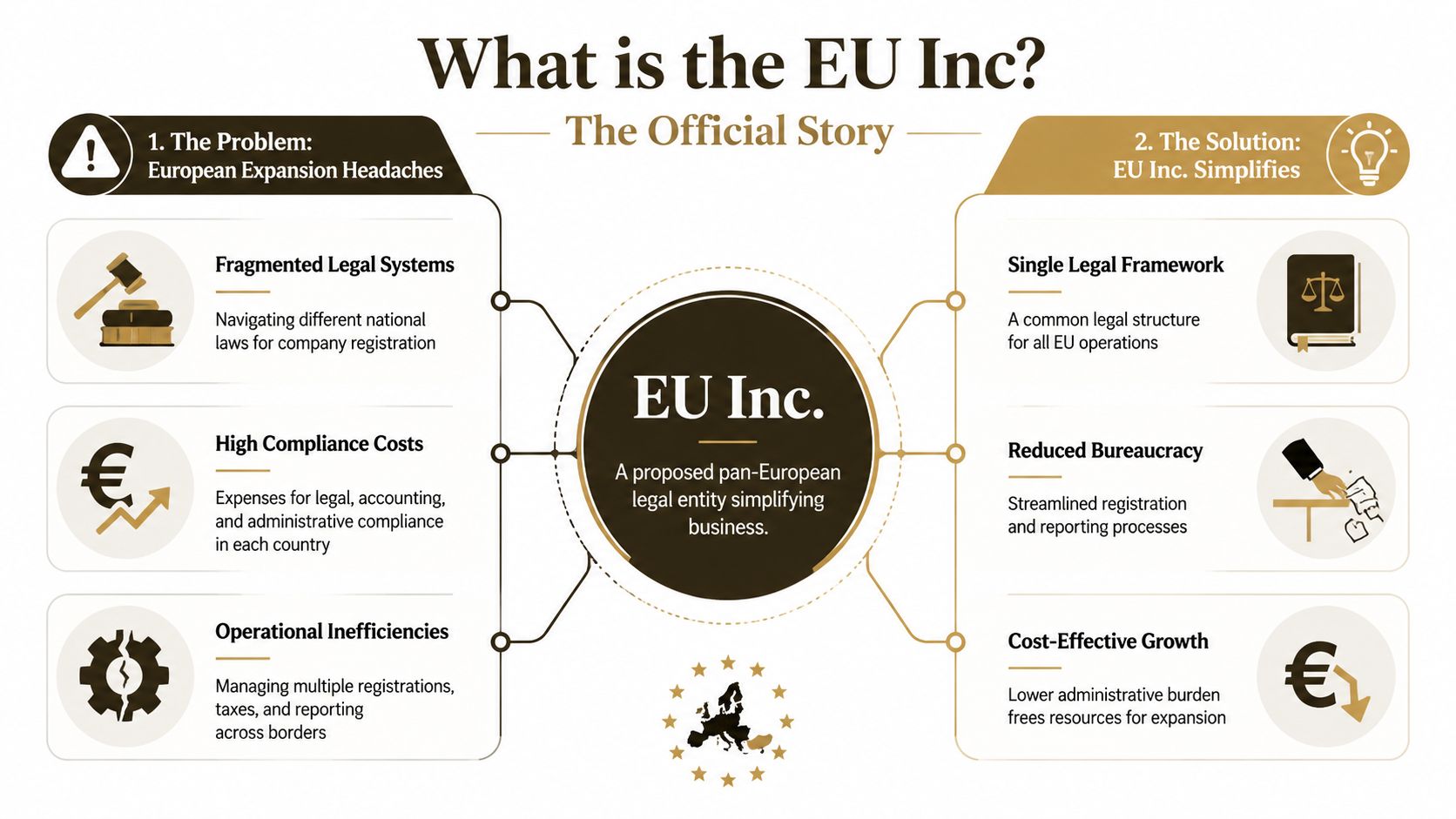
The confusion comes from the way people talk about it. Founders hear “EU company form” and assume it's already available. That's understandable, but wrong. The Commission's own framing is still proposal-stage, not launch-stage.
Practical rule: if you cannot point to the Commission proposal itself, you're looking at commentary, not the actual legal instrument.
A good founder should treat EU Inc. the way they'd treat any serious regulatory change. Real enough to plan around. Not real enough to build your current structure on it. That's the line.
The upside is that the core idea is not vague marketing. It is an official EU company-law proposal with a clear policy goal, to make cross-border formation easier and reduce friction in all 27 member states. If you're expanding across Europe, that makes it worth watching closely.
European expansion is still too messy for most founders. In practice, you run into multiple registers, different filing habits, local formalities, and the cost of maintaining more than one entity. That is expensive in money and distraction. It also slows down hiring, invoicing, and fundraising.
EU Inc. is the Commission's answer to that mess. Think of it as a single passport for your company. One EU-wide form. One rulebook. One legal identity that is meant to work across the whole Union if adopted.
The logic is straightforward. Instead of creating a German entity, then a French one, then an Italian one, the founder would use a harmonised EU-level company form designed to be valid across all 27 EU member states through a single interface.
This represents the core benefit. Not novelty for its own sake, but less fragmentation.
The Commission also says the company would be founded through a single EU-level interface, with information submitted once and then processed through linked national registers via BRIS. Founders care about that kind of setup because it means fewer duplicate filings and less administrative drag.
In practice, that looks like this:
The goal isn't to make European company law prettier. It's to make growth cheaper and faster.
For the plain-English version of the legal design, the 28th regime explainer is the right starting point.
EU Inc. is not a private workaround or a clever registry hack. It is a formal attempt to create a new, harmonised corporate legal regime for Europe, serious enough to plan around even while it's still in flight.
Start with the European Commission website, the cleanest check available. Search for “EU Inc proposal” or “company law package” on the Commission's company law and corporate governance page.
If you find a proposal page with the Commission as author and a legislative date, you're looking at the actual proposal, not a press post or a newsletter summary.
A real EU legislative proposal has a few obvious tells. It uses formal EU institutional language. It names the Commission as the proposer. It refers to a regulation or directive, not a product launch page. And it sits inside the EU's legal and policy pages, not on a marketing domain.
You can also check whether the document says the measure would be directly applicable across the Union. That's one of the key signs the proposal is built as a regulation, not a loose recommendation.
If you only see commentary saying “it will be universal,” be careful. Commentary is not the law.
If you want a second check, look at a legal analysis that quotes the proposal's operational features. A reputable note should mention the digital filing flow, the BRIS-linked process, and the 48-hour target once systems go live.
That's useful, it shows how practitioners are reading the proposal, not just how press coverage is spinning it.
A real proposal is specific. It sets out timing, scope, and legal form. In this case, the Commission says the proposal targets 48-hour incorporation, a maximum fee of €100, and no minimum share-capital requirement. Those are policy choices, not vague promises.
You should also notice what's missing. There is no live registration portal today, because the proposal is not in force yet. So if somebody tells you they can already form an EU Inc. for you, they're not describing the Commission's regime. They're describing a service layer or a future workflow.
Use that distinction. It saves time and stops people from making bad decisions based on hype.
The strongest reason founders are paying attention is simple. EU Inc. is designed to remove the stuff that slows you down when you expand across borders.
The promise isn't just “European” branding. It's less paper, fewer duplicates, and a company form built for operating in more than one market.
The Commission's proposal is direct on the core economics. It sets a 48-hour incorporation target, caps the fee at €100, and removes any minimum share-capital requirement. That combination is what makes the proposal attractive to lean founders, not the name.
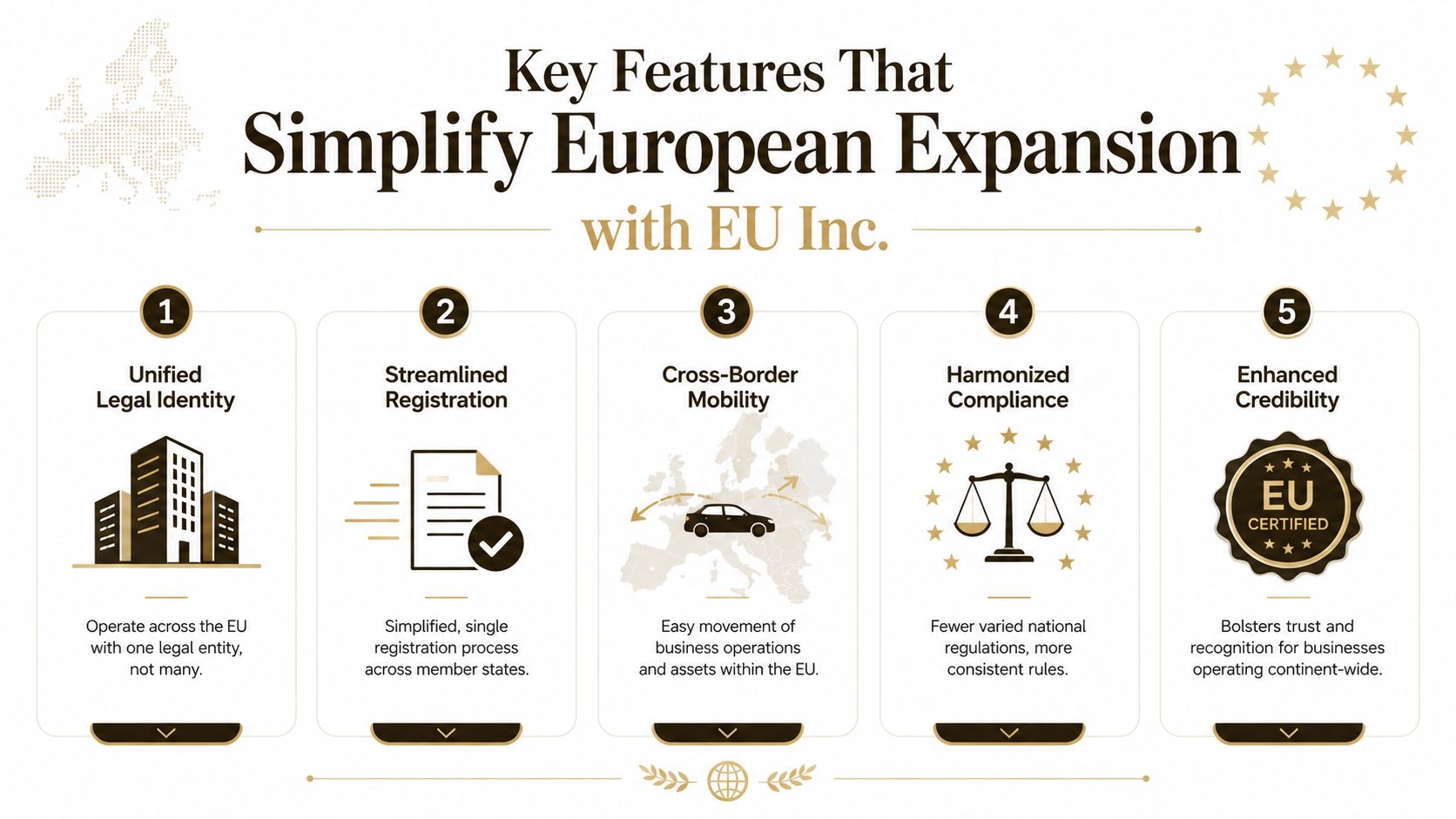
That is a cleaner launch path than the old country-by-country playbook. It also lines up with how modern founders want to work, remote first, lean, and fast.
The legal note on the proposal goes further and says founders should be able to complete incorporation online with no notary appointment and no physical attendance. That strips out one of the biggest friction points in many EU incorporations.
If your current setup forces local appointments, couriered signatures, and duplicate registrations, EU Inc. is aimed squarely at that problem.
For founders comparing options, the main question is operational, not ideological. Do you want one entity that can be used across the Union, or a stack of local subsidiaries and branch registrations? EU Inc. is built for the first path.
The first question is always taxes. Good. Ask it. EU Inc. has no special tax rate. National corporate tax still applies where you operate. This is not a tax haven and it is not a shortcut around local tax rules. The proposal changes the company form, not the tax system.
This is the point a lot of people miss: a harmonised company form can make incorporation easier, but it doesn't erase local tax reality.
If your business is active in a market, the local tax and VAT consequences still matter. The proposal does help by pushing data once into the system and sharing it digitally with tax authorities, which reduces duplicate filings.
The current public guidance points to Q1 2027 as the target launch window, with 24–48 hour processing once systems go live. Treat that as a target, not a guarantee. The legislative process can still shift details, and the implementation path matters.
But don't overread that uncertainty. The legal direction is already clear. The Commission wants a digital, regulation-based form that founders can use without a notary, with TIN and VAT numbers assigned digitally as part of registration. The rough shape is visible even if the final paperwork isn't settled.
There's also a broader founder stack forming around the proposal: EU-FAST, a standardized investment document set, and EU-ESOP, a standardized employee equity framework.
Those ideas matter because company form alone doesn't solve scale. Capital and talent incentives matter too. The direction is consistent, even if every part isn't final yet.
If EU Inc. fits your growth plan, use the waiting time well. Clean up your cap table. Map where you expect to sell, hire, and invoice.
Decide whether you need one operating company or a structure that can later split by function. That work helps no matter what the final legislation looks like.
You should also get your records in order. The proposed system is built around digital identity, once-only data flow, and standardized filings. The easier your ownership and management picture is today, the faster you can move when the registration system opens.
The right move now is not panic. It's readiness.
For the full breakdown of what changes for founders day to day, see EU Inc benefits.
Join the EU Inc. register waitlist if you want to stay close to launch timing and be ready when the official process opens. That's a low-cost way to avoid being late while everyone else is still asking what the proposal means.
No. It is designed as an additional EU-wide company form, not a forced replacement. You would still have national options. That matters because some founders will want the new regime and some will prefer their existing local structure.
The proposal is still moving, so don't assume conversion mechanics are final. What is clear is the intended operating model: a fully digital fast-track registration with once-only data flow to tax and other authorities, built to avoid notarial and paper-heavy steps.
If conversion ends up being available, the details will matter as much as the headline.
This is exactly why the regulation format matters. The Commission's design is meant to be directly applicable across all 27 EU member states rather than broken up into separate national transpositions. That doesn't remove implementation friction, but it reduces the chance of a permanently fragmented patchwork.
No. It makes one important part simpler, company formation. Everything around it, tax, hiring, banking, local compliance, still needs proper handling. But for founders who want a cleaner European structure, this is the first serious official move in years.
If you're building for Europe, stop treating EU Inc. as rumor. Treat it as an official proposal with real implications, then check the Commission source yourself and get ready for the launch window.
Start with the proposal page, keep your records clean, and join the waitlist if you want to move fast when the system opens.