
Europe is a great market to sell into. It's a frustrating market to structure around.
A founder starts with one country. Then a customer in another market wants a local invoice. Then a hire in a third country needs payroll. Soon the company chart looks like a patchwork of local entities, local counsel, local filings, and repeated admin.
That mess is what the 28th Regime is trying to fix.
If you care about speed, remote setup, and operating across Europe without rebuilding your company every time you enter a new market, this proposal matters. Especially if you live outside the EU and don't want your expansion plan to begin with notaries, residency questions, and country by country incorporations.
The practical promise is simple.
Instead of treating Europe as one market for sales but many markets for company setup, the 28th Regime aims to give founders one company form that works across the EU.
Today, a cross-border founder usually runs into the same sequence. Register locally. Learn local company rules. Repeat in the next country when expansion gets serious enough. Even when the commercial plan is clear, the legal structure slows everything down.
That friction isn't only legal. It changes how you operate.
You delay hires because payroll and labor setup are unclear. You postpone invoicing from the right entity. You leave investors with a messy cap table story because the structure was built one national workaround at a time.
Most founders don't struggle with demand first. They struggle with structure first.
The 28th Regime is the EU's answer to that problem. It tries to create a true single market for companies, not only for products and services.
For a founder, the appeal isn't ideological. It's operational.
You want a company form that lets you:
This matters even more for non-EU residents. The old model often assumes local presence, local advisors, and a tolerance for delay. Many remote founders don't have any of those. They need a structure that respects the way modern companies are built.
The legal label matters less than the business result.
The useful question is: if the 28th Regime goes live, what changes for hiring, invoicing, fundraising, and expansion across Europe?
And just as important: what doesn't change.
If you understand those two things, you'll see where this could save serious time and complexity, and where founders still need to plan carefully.
A founder in Brazil, India, or the US can already open a company in Europe. The hard part starts after incorporation, when one national company has to carry a business that hires, sells, and raises money across several EU countries. The 28th Regime is meant to reduce that mismatch.
The 28th Regime is the proposed framework behind EU Inc., also referred to as Societas Europaea Unificata. It would sit alongside existing national company forms, not replace them.
A company formed under it would be recognized across all 27 EU member states under a single EU-level rule set, as outlined in Notaria Online's overview of the proposal.

In practice, that means the company form is supposed to travel with the business. Founders would not need to start with one country's legal template and then keep explaining that choice every time they expand, open a bank account, or prepare for diligence in another member state.
Founders would still be choosing between options.
A local GmbH, SAS, or SL can still make sense for a business that will stay centered in one country, with one hiring base, one payroll setup, and investors who are comfortable with that local form.
EU Inc. is aimed at a different use case: companies that expect cross-border activity early and want one cleaner wrapper for that from day one.
That distinction matters for non-EU residents in particular. Many of the current workarounds assume local presence, local signatories, or country-specific legal habits. A more standardized form does not remove every practical hurdle, but it could cut a lot of early structuring work.
The proposal is built as an EU Regulation, not a Directive. That choice matters because a Regulation is designed to apply directly across member states instead of being rewritten country by country, which is the core point in Osborne Clarke's analysis of the proposed EU-wide company structure.
For founders, the point is simple. If the rules are more uniform, legal setup becomes less of a country-by-country project. Hiring still runs through local employment law. Tax still follows national rules. Sector licensing still stays local where required. But the company wrapper itself should be more predictable.
This is the critical "so what." The 28th Regime is not trying to erase national systems. It is trying to stop the company form from being the first operational bottleneck.
You are sitting outside the EU, ready to hire a designer in Portugal, sign customers in Germany, and raise from an investor in France.
With a national company, the first practical question is usually, "Which country do I commit to first?" An EU Inc. is meant to reduce that decision at the company-law level.

A national company is still a local form. Even if you plan to operate across Europe, the entity itself starts inside one country's rules, filing habits, and governance model. That often means founders spend early time solving for the wrapper instead of the business.
The proposed EU Inc. flips that starting point. It is designed as a single EU-level form for cross-border businesses, with digital formation and standardized core rules across member states, as explained in European Law Blog's review of the proposal.
For founders, the operational difference looks like this:
That does not mean one company can ignore national systems.
Hiring still follows local employment law. Invoicing still has to reflect local VAT and tax rules where they apply. Regulated activities still need local approvals. If you sell into three countries, you do not get to skip those three countries' operating rules just because the company form is European.
Here, the proposal gets practical.
For a non-EU founder, a national company often comes with small structural frictions that add up fast. You may need local guidance before you can even open the company.
You may find that service providers, banks, or counterparties are used to domestic patterns that assume a local founder, local signatory, or country-specific paperwork. None of that is impossible, it just adds time and cost before the business is properly running.
An EU Inc. is meant to reduce that front-end complexity. The pitch is simple: one recognizable company form that can be used across the single market, including by founders who do not live in the EU.
That's a meaningful difference if your team, customers, and capital sources are spread across multiple member states from the start.
There is still a real trade-off.
A national company can remain the better option if the business is concentrated in one country, your investors strongly prefer a familiar domestic form, or your accountant and legal counsel already have a clean local setup that fits the company well.
Founders do not win points for choosing the more novel structure. They win by choosing the one that creates less operational drag for the next two years.
That is also why the 28th regime should be read as an additional option, not a replacement for every existing company type. For the operational upside in practice, see EU Inc benefits.
A founder in Toronto signs a German customer, hires a contractor in Spain, and starts investor conversations in France. The question is not whether Europe offers demand. The question is whether the company structure helps or slows each next step.
This is where the 28th regime matters in practice. It gives founders a way to run cross-border activity through one EU company form instead of building a group structure earlier than the business needs.
That can cut repeated setup work, reduce duplicated legal coordination, and make governance easier to keep under control while the company is still small.

The benefit is straightforward. Fewer entities usually means fewer moving parts.
The biggest gain is operational focus. If sales, hiring, and fundraising are already spread across several member states, one company form is easier to run than a holding structure with local subsidiaries created mostly to satisfy company law differences.
In practical terms, founders may get:
This helps most at the stage where complexity arrives faster than revenue. A founder does not need legal elegance for its own sake. A founder needs fewer administrative decisions competing with product, customers, and hiring.
The company form may become more uniform. The operating environment does not.
The 28th regime is about company law. It does not replace local tax systems, payroll rules, social security registrations, or employment law. PwC makes this point clearly in its note on the tax and labor law fragmentation that remains under the proposal.
Founders should expect these limits from day one:
That last point matters more than many founders expect. A company can be legally valid and still create friction if a bank compliance team, payroll provider, or investor counsel has never worked with the form before.
For a startup selling across Europe from the start, the trade-off is often worth it. One company can mean less structural clutter, fewer repeated legal costs, and a cleaner story for investors and employees.
For a business that will operate in one country for the next two years, the advantage is less obvious. A familiar national company may still be easier if every counterparty, adviser, and hire is local.
This is the practical test I would use. Choose the 28th regime if cross-border activity is part of the operating model, not just a future ambition. If local taxes, payroll, and compliance will still sit in several countries anyway, at least the company layer should stop adding unnecessary friction.
The operational side is where the proposal gets interesting.
The framework is built around a digital-only lifecycle. Formation, filings, and later corporate procedures are meant to run through a central EU interface, rather than forcing founders back into paper-heavy local processes.
Greenberg Traurig's summary also notes the once-only principle, where company data is transmitted to authorities so founders don't have to keep resubmitting the same information for tax registration and related steps through the proposed central EU interface and automatic TIN and VAT assignment flow.
If the system works as intended, a founder should spend less time stitching together separate registrations after incorporation.
The practical effect is that company data would move outward from the registration process to the relevant authorities. That matters because one of the most annoying parts of company setup isn't forming the entity. It's all the follow-up admin that starts right after.
For founders, that's not a cosmetic improvement. It's the difference between "company formed" and "company usable."
The broader policy package also matters for startup operations.
Two names to know are EU-FAST and EU-ESOP.
The promise here is not that fundraising or equity suddenly become effortless. It's that some of the recurring legal fragmentation around startup paperwork could narrow.
A structure becomes useful when it helps with hiring and financing, not only incorporation.
There is still a real unknown for non-EU founders.
The proposal introduces the optional EU-ESO style approach, but public detail on how that interacts with non-EU founder residence and systems like US or UK tax treatment is still thin.
The European Commission describes the employee stock option scheme as a major innovation, but cross-border treatment for founders and team members outside the EU still needs careful review in real cases, as noted on the Commission's page covering EU Inc. and the proposed employee stock option framework.
The practical rule is simple.
Use the 28th Regime to simplify the company wrapper. Don't assume it has already solved every equity tax question for globally distributed teams.
The 28th Regime is not live yet. If you're still confirming this is a genuine proposal and not just talk, here's how to verify it.
As of mid-2026, it remains in active legislative negotiation. If agreement is reached by the end of 2026, the framework is projected to become operational in early 2027, with registrations expected to open in Q1 2027, according to the current legislative timeline tracked by the 28th Regime initiative.
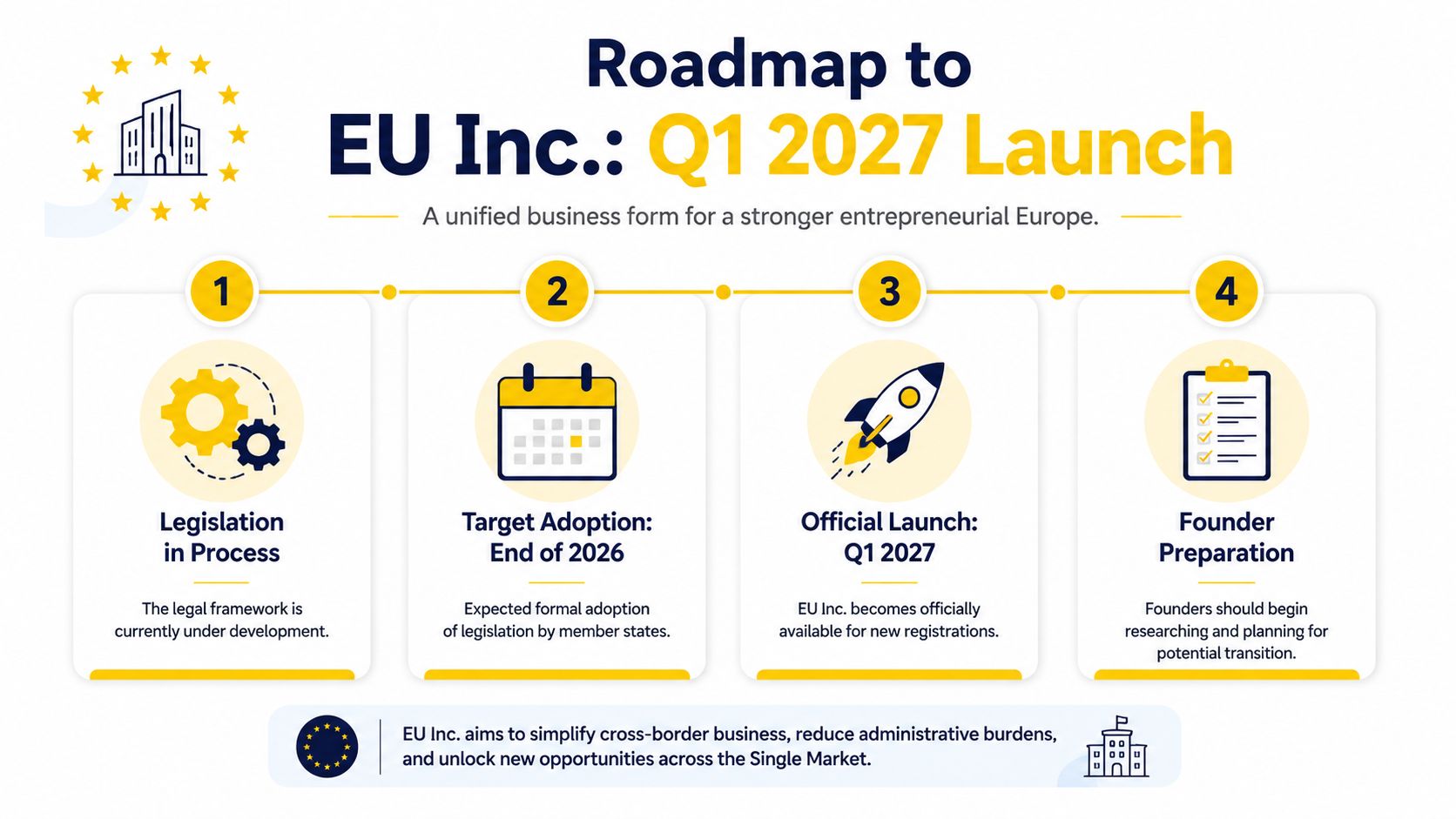
So the honest message is this: prepare seriously, but don't plan as if registration is open today.
You don't need to wait passively for launch.
You can use this period to decide whether EU Inc. would improve your setup.
Start with the operational map:
Founders who get the most value out of a new structure usually do the boring work early.
A waitlist can also be useful if Europe is part of your next operating phase and you want to be ready when registration opens. The point isn't hype. It's avoiding a scramble later.