
You're probably in this spot right now.
You have customers, hires, or investor interest in Europe. But the minute you try to turn that into a real operating setup, you hit the usual mess.
One country wants one process. Another wants a different company form. Another expects local paperwork, local filings, and local advice just to stay out of trouble.
That's why EU Inc benefits matter.
Not because founders love legal reform. They don't. They matter because founders want to sell, hire, and raise money in Europe without building a legal maze first.
For non-EU founders, the promise is simple. Set up one company that works across the EU, do it digitally, and stop wasting months on entity sprawl. For European scale-ups, the appeal is just as practical. Fewer moving parts. Cleaner operations. Less friction when your company starts crossing borders.
The catch is that EU Inc is still moving through the legislative process, so this is not something you can use today. But if you expect to build across Europe in the next wave, it's worth understanding now.
A founder lands a customer in Germany. Then a candidate in France. Then a distributor asks about Spain.
On paper, that sounds like momentum. In practice, it often turns into a legal admin project nobody wanted.
Instead of one expansion path, you get a patchwork. Different company rules. Different filing habits. Different local expectations. You end up asking the same question over and over: do we need a separate entity there?
The current system makes founders think country by country, not market by market.
That means you start stacking problems:
None of this helps you win customers.
It just delays the part of the business that matters.
Founders don't fail in Europe because demand is weak. They often stall because the setup burden arrives before the scale does.
If you're outside the EU, the old model is worse.
You're trying to enter a single market that doesn't feel single when you incorporate. You may find rules that assume local presence, local directors, local signatures, or local entity choices before you can do basic things cleanly.
That is a major frustration. Europe sells the idea of one market, but the company formation path has often forced founders to behave as if there were many.
For small teams, this is expensive in the most dangerous way. Not just in money. In focus.
Every week spent on legal structure is a week not spent on sales, hiring, product, or fundraising. And early-stage companies can't afford that trade.
EU Inc is the cleanest version of what Europe should have had years ago.
It's a single company form designed to be recognized across all 27 EU member states, built as a voluntary 28th regime that sits alongside national company forms instead of replacing them, according to this explanation of the 28th regime and national coexistence.
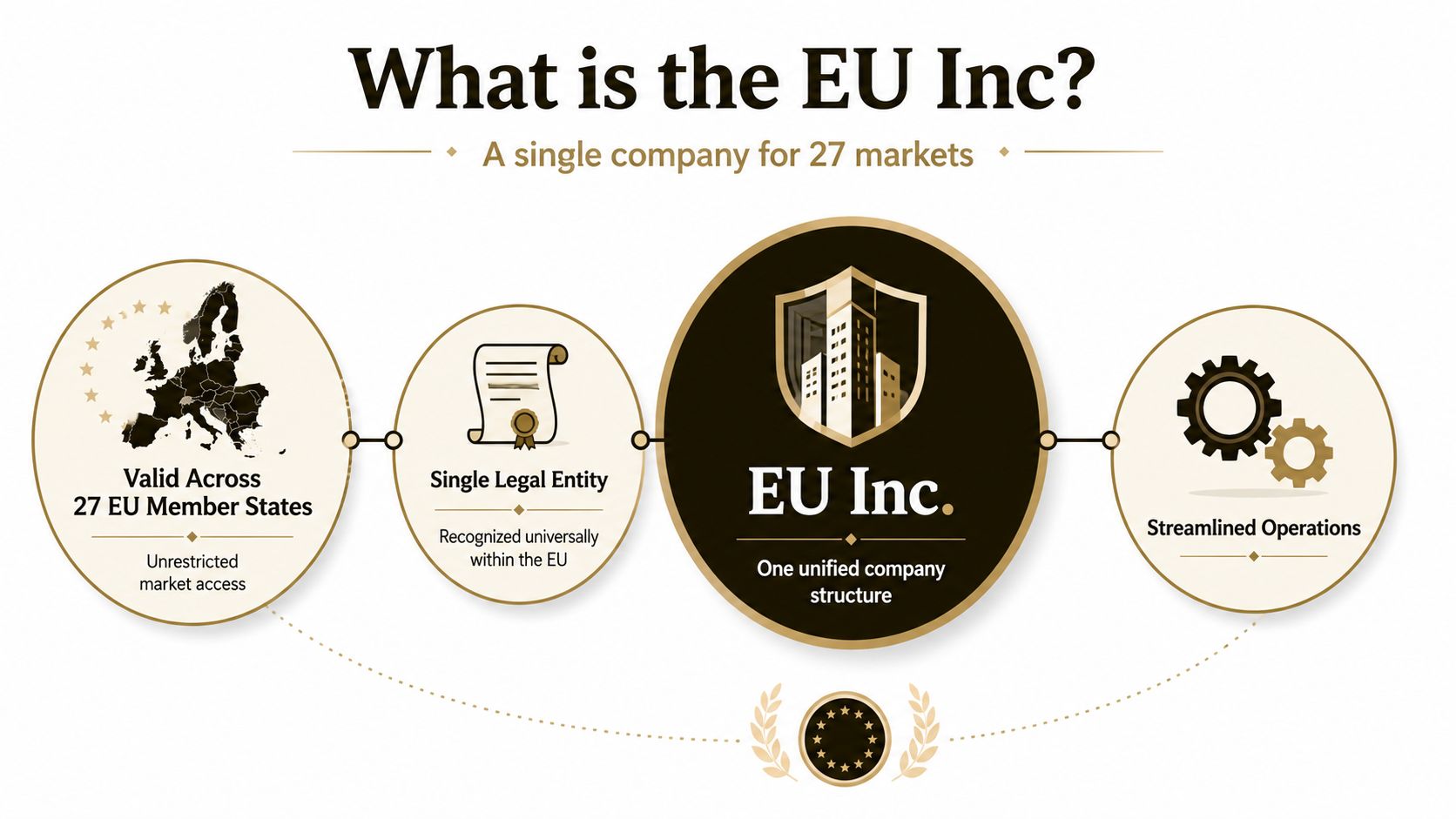
Today, founders often carry a heavy ring of legal keys. One key for each market. One setup for each country. One workaround after another.
EU Inc is meant to work like a master key.
You opt into one EU-level framework. That framework applies to the company. And conflicting national corporate rules for that entity are overridden by the EU rulebook. The practical point is what matters: one company, one structure, one operating base for the EU.
That's the part founders should care about.
Not the legal poetry. The operational effect.
If the framework lands as proposed, EU Inc would let founders stop treating Europe like 27 separate incorporation projects.
Here's the short version:
If you want the mechanics, the 28th regime explainer gives a useful overview without drowning you in legal jargon.
Practical rule: If your company expects to hire, invoice, or raise across multiple EU countries, one recognized entity is usually more valuable than a “perfect” local setup in the first market.
A non-EU founder usually hits the same wall fast. You want to hire a sales lead in France, sign customers in Germany, and test a support team in Portugal. Then the entity work starts eating weeks, legal fees, and management time.
That is where EU Inc gets practical.
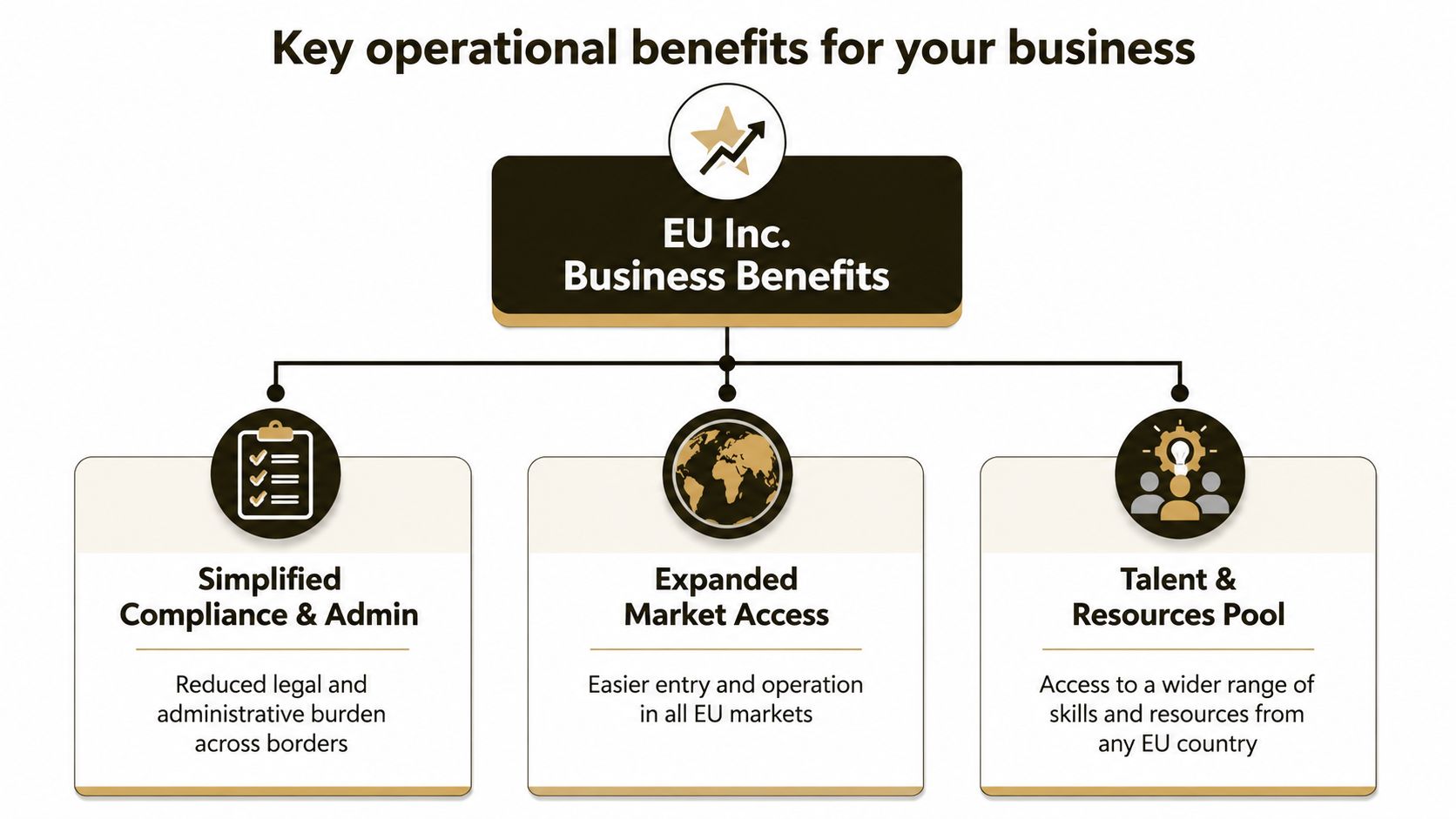
The headline benefit is speed with fewer procedural blockers. The proposal is built around fully digital incorporation, with registration handled through one EU-level process rather than a chain of local filings, notary appointments, and in-person steps. The European Commission's work on digital company law procedures points in the same direction.
Less paper, fewer physical formalities, and a cleaner path to getting a company live.
For founders, that changes the sequence of work.
You can set up the company, open operations, start hiring, and invoice customers without waiting for each country to impose its own incorporation ritual first.
That does not remove every post-launch task. Banking, payroll, sector licensing, and local employment compliance still exist. It cuts out a large chunk of avoidable company-formation drag.
The operational win is simple. You stop building Europe one subsidiary at a time.
If the framework launches as proposed, one company should let you do the work that usually pushes founders into a patchwork of local entities too early:
That matters most for non-EU founders. If you're based in the US, UK, India, or Latin America, Europe stops looking like 27 separate legal projects and starts looking like one region you can enter with a real operating base.
Scale-ups gain something different. They get cleaner execution. Finance, legal, and people ops spend less time maintaining duplicate company records and more time supporting actual expansion.
Here's a useful explainer if you want a quick visual summary before reading on:
Cross-border hiring usually breaks down at equity.
A stock option plan that works in one country can become awkward or expensive in another. Founders end up offering cash instead of ownership, or they create exceptions market by market. Both choices are bad. Cash burns faster. Exceptions create admin mess.
EU Inc is meant to improve that. The proposal includes EU Employee Stock Options, or EU-ESO, with tax treatment deferred until sale rather than hitting employees earlier in the option lifecycle.
For a scale-up hiring across several EU countries, that's not a minor drafting detail. It makes equity easier to explain, easier to accept, and more realistic to use as part of compensation.
The bigger gain is operational consistency. You can recruit with one equity story instead of rewriting the offer every time you hire in a new country.
That still does not mean every tax problem disappears. Local tax administration and employment rules will still matter in practice. But if EU Inc gives founders one company and a more usable cross-border option framework, it removes two of the biggest reasons European expansion gets messy early.
You are running a company from New York, London, Bangalore, or São Paulo. A prospect in Germany wants a local contract. Your next engineer is in Portugal. An investor asks how you plan to cover Europe without creating three subsidiaries in year one.
EU Inc is built for that situation.
The clearest fit is a founder outside the EU who wants to sell, hire, and operate in Europe without choosing one country too early and getting boxed in by that decision.
What do you gain in practice? A cleaner starting position. You set up one company, handle formation remotely, and use that entity as your base for EU expansion. You spend less time on local incorporation rituals and more time on revenue, hiring, and compliance that affects operations.
That matters if you are testing several markets at once. A SaaS company selling into France, the Netherlands, and Spain does not want its legal setup to force a long-term bet on one member state before the business has earned it.
EU Inc also fits companies that have moved past single-country operations, even if their structure has not caught up yet.
These teams usually have the same problem. Sales are regional. Hiring is regional. Product support is regional. The legal setup is still a patchwork of national entities, local filings, and custom workarounds.
That mismatch costs money.
A single company form helps most when your business already works across Europe and your legal structure keeps slowing it down. Instead of rebuilding contracts, approvals, and governance country by country, you get a common base to operate from.
For a scale-up, that's the key benefit: faster execution, fewer entity decisions, and less founder time wasted on structure.
The equity piece also matters here. As noted earlier, the proposed EU-ESO approach aims to make cross-border stock options more usable for startup teams hiring in multiple EU countries. For founders competing for senior talent, that means a better shot at offering ownership instead of replacing equity with more cash.
There is another group that should care. The people who have to make the structure work after the founder says, "let's expand in Europe."
CFOs want fewer entities to manage. Legal teams want fewer one-off exceptions. Startup advisors want a standard route they can recommend without rebuilding the plan for every country combination.
EU Inc will not erase local employment law, tax administration, or sector-specific rules. It does not turn Europe into one compliance regime. But it should cut a lot of repetitive company-law work for businesses that need a regional operating setup.
This is really who it's for: non-EU founders who want a real EU base, and scale-ups that need Europe to function like one business instead of 27 separate paperwork projects.
Let's kill the biggest myth first.
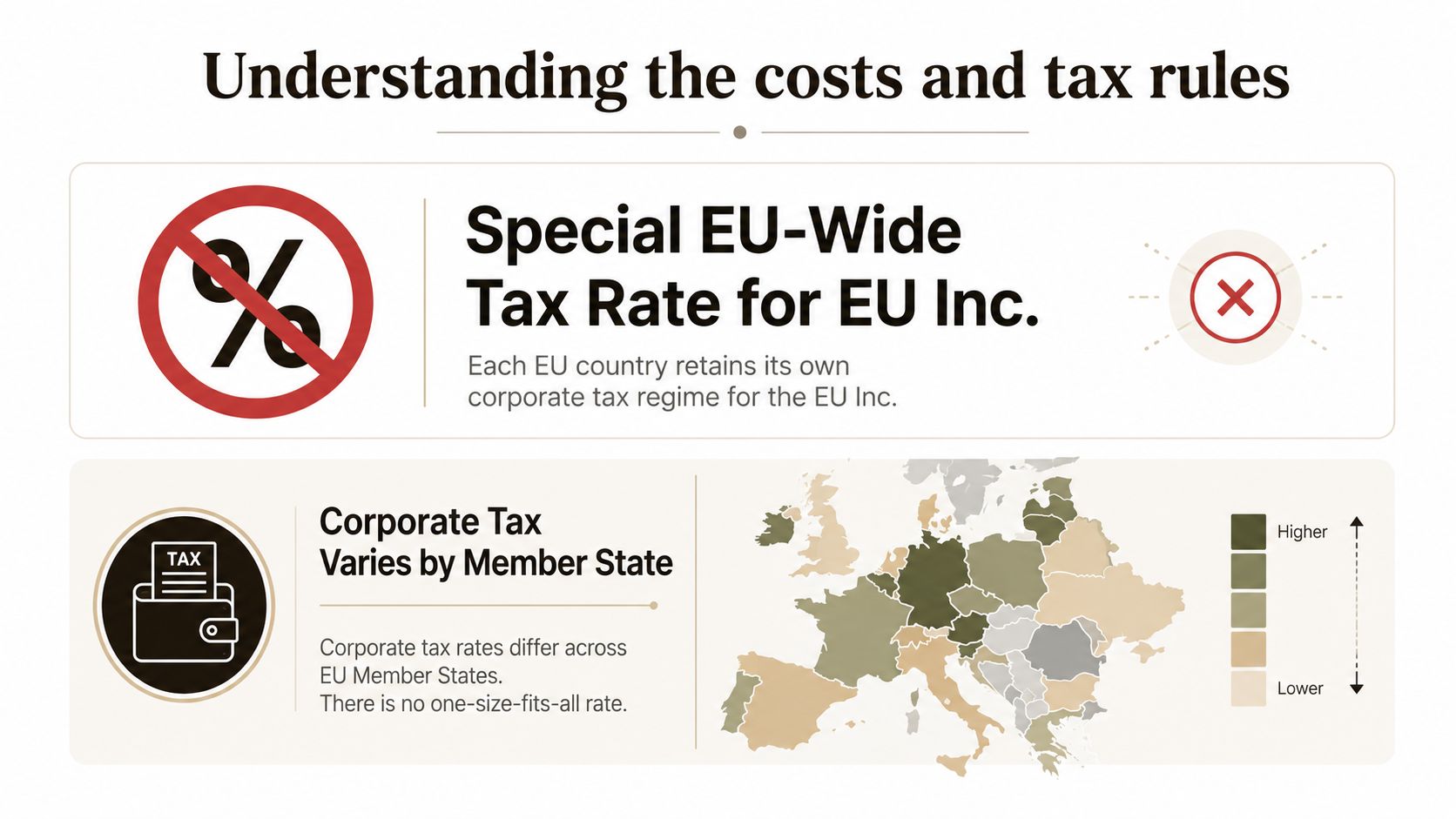
EU Inc does not create a special EU-wide corporate tax rate.
Corporate tax still applies at the national level where the company operates. That's the right way to think about it. EU Inc is a company law and operating framework benefit. It is not a magic tax loophole.
The meaningful savings are in formation friction and entry cost.
Under the proposal, the statutory registration fee is capped at €100 and companies can be founded with as little as €1 in capital, in contrast to the existing Societas Europaea, which requires €120,000 minimum capital, according to the European Commission announcement on EU Inc.
That's a huge practical shift.
A founder doesn't need to lock up serious capital just to access the structure. And the fee cap keeps the official registration path predictable.
These aren't cosmetic numbers.
They change who can use the structure.
That's why I'd frame EU Inc as a startup-first European company form, even if the legal text uses more formal language.
It's trying to remove the old “Europe is only for well-funded companies” problem.
Cost savings on registration don't erase the rest of the work.
You still need to think about:
The smart way to budget for EU Inc is this: expect lower setup friction, not zero operating obligations.
That distinction matters. It keeps you from overestimating what the reform does while still seeing the genuine benefit.
Founders need a clear-eyed view.
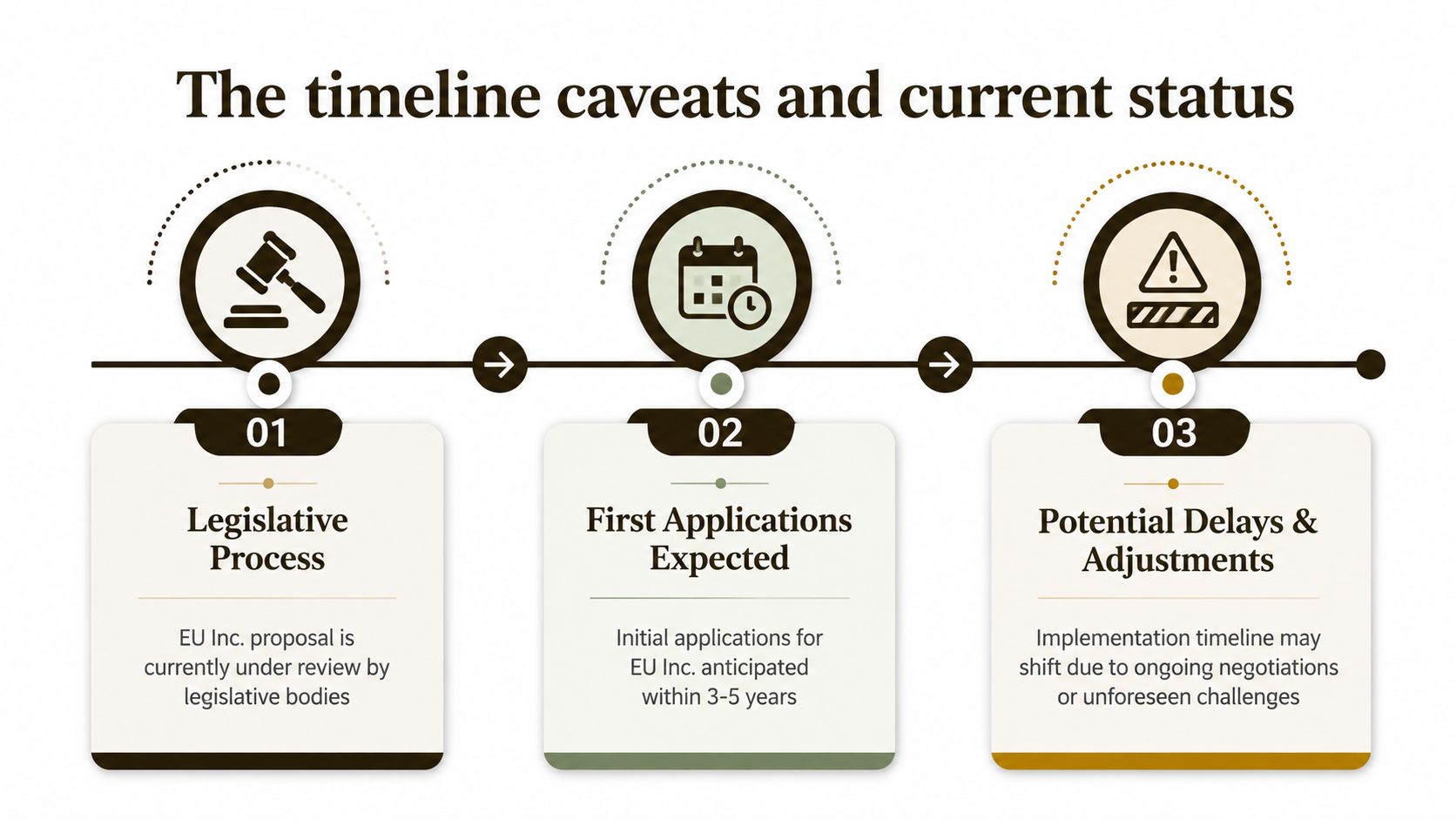
EU Inc is still in the legislative process. Treat it as a coming tool, not a current option.
The broad planning assumption to use today is Q1 2027 for launch readiness. That's the honest working timeline, not because the text says “go live and everything is perfect,” but because implementation takes time and early operational reality will lag behind legal approval.
The 48-hour incorporation window is contingent on using standardized contract templates, and without those templates formation may take weeks, according to Bruegel's analysis of the implementation caveats.
That's important.
If you're a founder with a straightforward setup, the fast route could be very attractive. If you need bespoke governance, custom shareholder rights, or unusual structuring, you should expect more time.
So don't read “48 hours” as “every company, every case, instantly.” Read it as the best-case path for standardized formations.
The same analysis projects the first EU Inc registrations for late 2026, with full operational impact only arriving 9 to 12 months later, creating an adoption lag until Q1 2027.
That adoption lag is normal for a new legal form.
Systems need to connect. Advisors need to learn the mechanics. Payroll and internal workflows need to catch up. Founders need a few early examples before they trust the path fully.
That's why I wouldn't tell a company forming today to freeze and wait.
I'd tell them to plan in layers:
The risk here isn't that EU Inc is pointless.
The risk is that founders hear the clean headline and ignore rollout friction.
That would be a mistake. But so would dismissing the reform because it won't be perfect on day one.
EU Inc still looks materially better than the status quo for the companies it's aimed at. You just need to budget for a phased rollout, not a magic switch.
If EU Inc fits your roadmap, don't wait until the portal opens to start thinking.
Do the boring prep now. That's what makes the launch useful later.