
EU Inc is not live yet. When it launches, the target is 48 hours, the registration fee is capped at €100, and there's no minimum share capital. A non-EU founder can do it 100% digitally once the regime opens, with Q1 2027 still the working launch window.
That's the good news. The question is whether it solves the grind you care about, invoicing EU customers, hiring across borders, and avoiding a mess of local entities, tax IDs, and filings. It helps with the first part. It does not erase the second part.
If you're a founder in São Paulo, Lagos, Singapore, or anywhere outside the EU, you're probably asking the same four things. Can I register without moving? How fast is fast? What paperwork do I really need? And what compliance pain comes back after incorporation?
You're not looking for a theory lesson. You're looking for a clean way to sell into Europe without setting up a company in one country, then another, then another.
That's the founder's problem in plain English. One company. One filing flow. One set of core documents. No local desk in every market just to get started.
But EU Inc is still a proposal, not a live incorporation product. The Commission is still moving it through the legislative process, and the current expectation is Q1 2027 for launch, not today. The smart move is to treat it as a coming route, not an active shortcut.
Practical rule: plan around the filing you'll need on day one, then plan again for the tax and payroll work that begins after day one.
This guide is for that second part as much as the first. It answers what EU Inc requires, who can use it, what the digital filing flow looks like, and where the sales pitch stops. It does not replace local legal or tax advice for your exact structure, especially once you start hiring or selling in multiple countries.
For the official product path, keep an eye on What EU Inc is and how it works. If you want to be ready when the window opens, the EU Inc registration waitlist is the sensible place to start.
EU Inc is best understood as a new corporate layer, not a replacement for national company law. It works like a passport. You still have a home country, but the passport lets you move through a wider area with one document.
That is the point of the proposed 28th regime. It sits above national company forms, so a founder can register once and operate across all 27 EU member states through a single digital process instead of stitching together separate national companies one by one. The Commission says the system would use the Business Registers Interconnection System, BRIS, as the backbone for that central filing flow, with onward transmission to tax and corporate authorities for things like TIN and VAT issuance. European Commission overview of EU Inc
That structure changes the unit of expansion. Under the current model, many founders still pick one member state, incorporate there, then add entities as they scale. EU Inc is meant to reduce that drift into entity sprawl from the start.
The point is cost and friction.
The Commission's own impact assessment, as summarized independently, projects €328 million to €440 million in administrative-cost savings over 10 years, with roughly 308,000 companies using the regime in that period. Those are policy-scale numbers, not founder promises, but they show the direction of travel.

For founders, the value is not a shiny label. It is a cleaner first filing, fewer country-by-country setup steps, and a corporate form that is built to sit above national borders. That still leaves the hard work of payroll, VAT handling, and ongoing compliance once the company starts operating in more than one market, which is where a modern GC responsibilities overview becomes relevant.
EU Inc should be read as a cross-border company form first, and a filing simplifier second. If you miss that, you will overestimate what it does for operations and underestimate what it does for incorporation.
The requirements are simpler than most national incorporations, but they're still real requirements. Don't confuse a lighter process with no process.
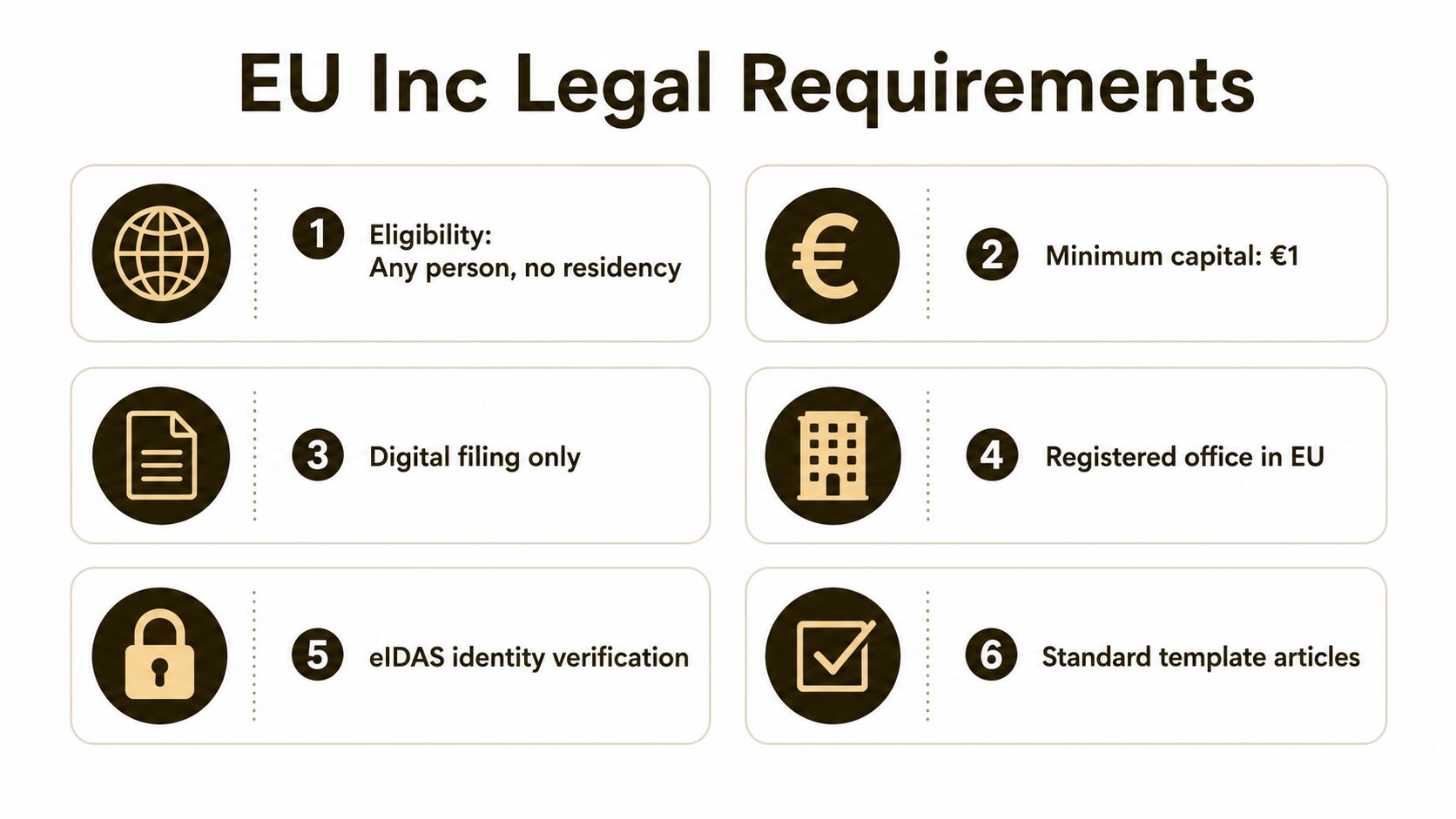
The best shortcut is to think in terms of what you must prepare before the portal opens. If your articles are sloppy, you'll slow yourself down. If your founder ID isn't usable in the EU filing system, you'll slow yourself down again. If you don't know where your registered office sits, you're not ready.
The proposal uses a tiered registration model. The fast-track route uses EU standard templates and is targeted at 48 hours with a maximum fee of €100. A separate route for custom articles is set at 5 working days. (Schoenherr practical analysis of the proposal)
That distinction is useful. It tells you where the speed lives. Standardization buys speed. Custom drafting costs time.
For a general management lens, the modern in-house side of this looks a lot like the expectations in modern GC responsibilities overview, especially if your company will cross borders quickly and need legal coordination early.
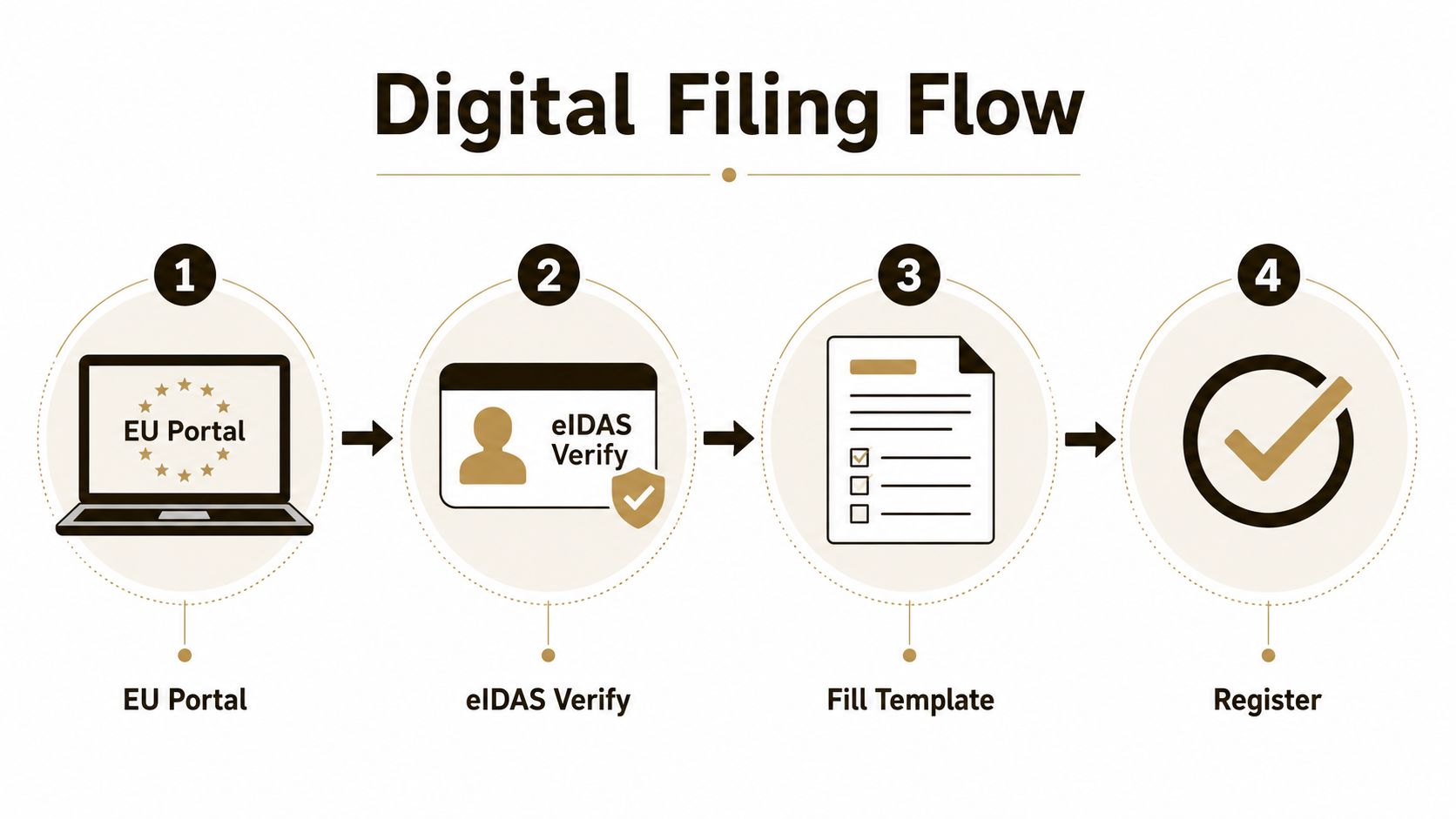
The filing flow is simpler than the old national stack because you submit once and the system forwards the details. That is the point.
You start on a central EU portal. You verify your identity with an eIDAS-compliant method. You complete the standard template, or upload custom articles if you are using the slower route. Then you file once.
From there, the company data moves through BRIS to the relevant member state registry. The proposal also says the same data is transmitted onward to tax and corporate authorities, including workflows for the TIN and VAT identifiers, so you are not repeating the same submission to every office by hand. The Commission describes this as a once-only principle, and that is the right idea for founders who hate duplicate paperwork. (Commission proposal PDF)
Timing is the nuance that matters. The 48-hour clock is a target tied to the fast-track route, not a promise that every registration in every member state will feel identical on day one. The regime is meant to work across all 27 EU member states through one digital process, but national implementation still matters.
Your job is to deliver correct inputs once. The system is supposed to route them outward. That cuts repeated filing, but it does not remove the need to keep company data clean over time.
The portal solves incorporation friction. It does not solve sloppy internal records.
This is the part most marketing copy glides past. Don't make your decision on the incorporation story alone.
EU Inc does not give you a special tax rate. Corporate tax still applies at the national level where you operate. If you earn income through an EU Inc company, you still need to care about the tax rules of the country of registration and the countries where you do business.
It also does not make VAT disappear. If you sell across borders, VAT still exists. The proposal's once-only data flow may help you get identifiers issued during registration, but that's not the same thing as being exempt from VAT registration, OSS logic, or country-specific filing duties. The Commission proposal itself says the once-only principle would send company data to tax authorities, social security bodies, and beneficial ownership registers, while national employment and social laws remain in force and the safeguards of the country of registration apply in full. (Commission proposal PDF)
This is the part founders underestimate.
That's why I'd treat EU Inc as an incorporation simplifier, not an operating-model simplifier. It gets you into the market with less friction. It doesn't run the business for you.
If you are outside the EU, the first thing to understand is what the proposal does not require. You do not need citizenship. You do not need residency. You do not need a local director. You do not need to show up in person just to file.
That matters because it cuts out a lot of old incorporation friction. The proposal points to a fully digital process, so the usual checklist built around notary appointments, travel, and in-country paperwork gets much shorter. The wider rollout is still a proposal, with Q1 2027 still the projected launch window.
You still need a bank account. You still create tax consequences somewhere. Before your first hire, get local counsel involved so payroll and employment issues do not surprise you later.
That legal work is where the primary setup cost sits. A founder can get the company formed fast and still run into delays on banking, VAT registration, payroll setup, or employer obligations in the country where the business ultimately operates.
If your founder profile is closer to a remote professional than a brick-and-mortar operator, the practical setup can overlap with migration planning too. A good example of that broader mobility context is digital nomad visa spain, especially if you are comparing residency options with your company setup.
EU Inc starts to make sense when you pair it with the other pieces of the EU startup stack. EU-FAST is the proposed standardized investment document, similar in spirit to a European SAFE note. EU-ESOP is the proposed harmonized employee equity route. Together, they point to a more coherent startup toolkit, not just a quicker incorporation form.
That matters if you plan to raise or hire soon after launch. Incorporation is only one step. Investment paperwork and equity design usually arrive right behind it.